
Grasshopper Amazing Facts — The Insect That Hears With Its Belly and Becomes Something Else Entirely Under Crowding

The grasshopper is one of the most familiar insects in meadows and grasslands worldwide — yet most people are entirely unaware that this common insect is hiding two extraordinary secrets. It hears using organs on its abdomen rather than its head, and under certain conditions it can undergo a complete personality and physical transformation, becoming a completely different-looking creature that swarms in billions. Here are the most amazing grasshopper facts!
👂 Ears on the Abdomen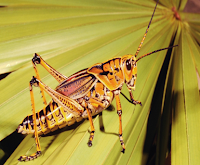

Grasshoppers do not have ears anywhere near their head — their hearing organs, called tympanal organs, are located on the first segment of their abdomen, just behind the hind legs. These tympanal organs are thin, membrane-covered structures that vibrate in response to sound waves, functioning similarly to an eardrum but positioned in a completely different part of the body from the head-mounted ears of most animals. This abdominal hearing is primarily used to detect the species-specific chirping calls of other grasshoppers — both potential mates and territorial rivals — with each grasshopper species producing a distinctive call pattern that others of the same species can recognise and respond to.
🎵 Singing With Their Legs
Most grasshopper species produce their characteristic chirping sound through a process called stridulation — rubbing a row of tiny pegs on the inner surface of the hind leg against a hardened vein on the forewing to create a series of rapid sound pulses. Different species vary in the speed, pattern and pitch of their stridulation, producing species-specific songs that are used for mate attraction, territory establishment and communication. In many grasshopper species, only males stridulate — their songs serving primarily to attract females and warn rival males — while females are largely silent but capable of responding to male calls through subtle movements that signal receptiveness.
🔄 The Incredible Jekyll and Hyde Transformation
One of the most extraordinary facts in insect biology is the grasshopper's capacity for a complete physical and behavioural transformation triggered by population density. Under normal low-density conditions, grasshoppers are solitary, relatively sedentary insects that actively avoid contact with each other. However, when population density increases beyond a threshold — triggered by overcrowding that causes hind leg contact between individuals — a cascade of neurochemical and hormonal changes begins that transforms the grasshopper into an entirely different-looking creature. The solitary form and the gregarious "locust" form of the same species differ in body colour, wing length, body proportions and behaviour — the gregarious locust form is attracted to rather than repelled by other individuals, flies in swarms rather than living solitarily, and migrates rather than remaining in one location. This transformation between the two forms is one of the most dramatic examples of phenotypic plasticity — the ability to produce dramatically different physical forms from the same genetic material — found anywhere in nature.
🌾 The Locust Plague Explained
The notorious locust swarms that have devastated crops and threatened food security across Africa, the Middle East and Asia for thousands of years are simply enormous aggregations of grasshoppers that have undergone the density-triggered transformation to the gregarious locust form. Desert locust swarms — the most destructive recorded — can contain up to 80 million individuals per square kilometre, cover areas of hundreds to thousands of square kilometres, and consume the equivalent of the daily food of 35,000 people in a single day of feeding. The transformation from harmless solitary grasshopper to devastating locust can occur within a generation when suitable rainfall triggers rapid vegetation growth that supports unusually high grasshopper population densities.
🦘 Remarkable Jumping Ability
A grasshopper's jumping ability is extraordinary relative to its size. Most species can leap distances of 20 times their own body length in a single jump — using their powerful, spring-loaded hind legs that store elastic energy in specialised leg tendons and release it explosively for maximum jump distance. In addition to jumping for escape, many grasshopper species fly considerable distances — migrating grasshoppers are capable of sustained flight of hundreds of kilometres, aided by favourable winds. The combination of leaping and flight ability makes grasshoppers among the most mobile small insects in their environments.
🌍 Found on Every Continent Except Antarctica
There are approximately 11,000 recognised grasshopper species distributed across every continent except Antarctica, occupying habitats ranging from tropical rainforests and temperate grasslands to semi-arid scrublands and high-altitude meadows. This extraordinary diversity of species reflects millions of years of evolutionary radiation into different ecological niches across the full range of terrestrial vegetation types, with different species specialising in different plant food sources, microhabitats and breeding strategies.
Secret ear locations, Jekyll and Hyde transformations and jumping 20 times their body length — the grasshopper is far more extraordinary than its ordinary appearance suggests. 🦗


Comments
@ Sancheeta ..hmmm thanks for your valuable comment:)
keep visiting:p
hehe mohinee thanks dear:)
some creatures are so useful, some are equally harmful!
Check and balance policy!
Anyway, I liked your hopping GREEN grasshopper- good for my tired eyes! :)
@ all thanks for visiting!!!