Posts

Showing posts from November, 2025

Chilean Four-Eyed Frog Facts — The Frog That Tricks Predators With False Eyes

Image
The Chilean four-eyed frog is one of the most bizarre and fascinating amphibians in all of South America — a small, stout frog that has evolved one of the most startling anti-predator defensive strategies found anywhere in the animal kingdom. When threatened, this frog presents a completely different rear end to its attacker — revealing a pair of striking, eye-like gland markings on its rump that transform it from a small vulnerable frog into something that looks far more dangerous. Here are the most amazing Chilean four-eyed frog facts! Did you know? The Chilean four-eyed frog gets its name from two large, eye-like spots on its hind end that it reveals to predators by tilting its body. These false eyes make the frog look suddenly like a much larger, more dangerous animal — and the "eyes" can also secrete toxic chemicals! 👁️ False Eyes That Confuse and Poison When a predator approaches the Chilean four-eyed frog, the frog performs a remarkable defensive display — it lowers i...

Anteater Amazing Facts — The Toothless Giant With the Longest Tongue

Image
The giant anteater is one of South America's most extraordinary and unmistakable animals — a large, slow-moving creature with an impossibly long snout, a bushy tail almost as long as its body, and no teeth whatsoever. Yet despite looking remarkably ill-equipped for survival, the anteater is one of the most specialised and successful mammals in the Americas, consuming up to 35,000 insects every single day using one of the most remarkable tongues in the entire animal kingdom. Here are the most amazing anteater facts! Did you know? The giant anteater's tongue is 60 centimetres long, covered in thousands of tiny, backward-facing spines coated in sticky saliva, and can flick in and out of its mouth up to 150 times per minute — capturing insects faster than the human eye can follow! 👅 The Most Remarkable Tongue in the Americas The giant anteater's tongue is one of the most specialised feeding tools found in any mammal. Measuring approximately 60 centimetres in length, it is c...

Agouti Amazing Facts — The Only Animal That Can Open a Brazil Nut

Image
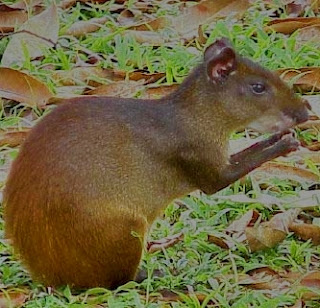
The agouti is a medium-sized South American rodent that most people outside the Americas have never heard of — yet this seemingly ordinary forest animal plays one of the most ecologically vital roles in the entire Amazon rainforest. Without the agouti, one of the world's most economically important nuts would have no natural dispersal mechanism whatsoever. Here are the most amazing agouti facts that reveal why this overlooked rodent is one of the Amazon's most essential inhabitants! Did you know? The agouti is the ONLY animal in the world with teeth strong enough to gnaw through the extraordinarily hard outer casing of a Brazil nut pod — making it the sole natural dispersal agent for Brazil nut trees, which cannot reproduce without the agouti's help! 🌰 The Only Key to the Brazil Nut's Vault Brazil nuts are enclosed within an extraordinarily hard, woody pod that can withstand the weight of a falling tree without cracking — a natural security system so effective that v...

Tomato Frog Amazing Facts — Madagascar's Most Colourfully Defended Amphibian

Image
The tomato frog is one of Madagascar's most visually striking animals — a plump, round frog coloured a vivid, unmistakable bright red-orange that resembles a ripe tomato so closely that its common name is entirely self-explanatory. But this frog's remarkable colour is not merely decorative — it is one of nature's most effective warning systems, advertising a biological defence so unpleasant that most predators learn from a single encounter never to approach a tomato frog again. Here are the most amazing tomato frog facts! Did you know? When a snake or other predator grabs a tomato frog, the frog's skin immediately releases a thick, white, sticky mucus that glues the predator's mouth, eyes and nostrils shut — forcing it to release the frog immediately and spend considerable time trying to remove the glue! 🍅 A Colour That Says "Don't Even Try" The tomato frog's vivid red-orange colouration is a classic example of aposematism — the biological use of...

Mussel Amazing Facts — The Ocean's Tiny Water Purifiers With Superhero Glue

Image
Mussels are among the most commonly eaten shellfish in the world, yet these small, blue-black bivalves are hiding some genuinely extraordinary biological secrets. From producing an adhesive stronger than most commercial glues to filtering hundreds of litres of seawater daily, mussels are far more remarkable than their familiar appearance on restaurant menus might suggest. Here are the most amazing mussel facts! Did you know? Mussels produce incredibly strong adhesive threads called byssus threads that can hold them firmly to rocks even in violent storm waves — and scientists studying this glue are working to recreate it for use as a surgical adhesive that works in wet conditions, something no existing medical glue can do! 🧵 Glue Stronger Than Commercial Adhesives Mussels anchor themselves to rocks, pier pilings and other hard surfaces using a remarkable structure called the byssus — a bundle of extremely tough protein threads secreted by a specialised gland at the base of the mussel...

Yak Amazing Facts — The High-Altitude Giant That Keeps Himalayan Civilisation Alive

Image
The yak is one of the most extraordinarily adapted large mammals on Earth — a massive bovine built specifically to thrive in the extreme cold and thin air of the Himalayan plateau, where temperatures plunge to minus 40 degrees Celsius and oxygen levels leave most other large mammals gasping. For thousands of years, yaks have been the foundation animal of Himalayan human civilisation, providing everything from transport to milk, meat, fibre and fuel. Here are the most amazing yak facts! Did you know? A yak's blood contains approximately three times the red blood cell concentration of ordinary cattle, allowing them to absorb sufficient oxygen at altitudes of up to 6,100 metres — higher than most humans can survive without supplemental oxygen! 🩸 Blood Engineered for Thin Air The yak's most remarkable biological adaptation is its blood. Wild yaks regularly live at altitudes of 4,000 to 6,100 metres above sea level — altitudes at which most large mammals would experience severe alt...

Temnospondyl Amazing Facts — The Ancient Amphibians That Ruled the World Before the Dinosaurs

Image
Before the age of dinosaurs, before the first reptiles had diversified, before even the ancestors of modern amphibians had evolved — the temnospondyls ruled the world's swamps, rivers and shallow seas as the dominant large predators of their time. These extraordinary ancient amphibians lived for an almost incomprehensibly long period of geological time, surviving multiple catastrophic mass extinction events and outlasting dozens of other major animal groups. Here are the most amazing temnospondyl facts! Did you know? Temnospondyls were so successful that they survived for over 200 million years — from the early Carboniferous period right through to the Early Cretaceous, meaning some temnospondyls lived alongside the earliest dinosaurs and even some of the earliest flowering plants! ⏳ 200 Million Years of Dominance The temnospondyls represent one of the most extraordinarily long-lived animal groups in the entire fossil record. First appearing approximately 330 million years ago duri...

Newt Amazing Facts — The Amphibian That Can Regrow Its Heart

Image
Newts are semi-aquatic amphibians belonging to the salamander family, found across the temperate regions of Europe, North America and Asia. Despite their small, unassuming appearance, newts possess one of the most extraordinary biological capabilities found anywhere in the vertebrate world — a capacity for tissue regeneration so remarkable that scientists studying it believe it could eventually transform human medicine. Here are the most amazing newt facts! Did you know? Newts can regenerate not just limbs but also eyes, jaws, hearts and significant portions of their spinal cord after injury — and they can regrow the same limb repeatedly throughout their lifetime with no reduction in quality each time! 🔬 The Animal That Can Regrow Its Own Heart The newt's regenerative abilities are among the most extraordinary found in any vertebrate animal on Earth. While many simpler animals like starfish can regenerate body parts, newts achieve regeneration at a level of biological complexity ...

Octopuses, Octopi and Octopodes — The Ocean's Most Alien Minds

Image
If extraterrestrial intelligence exists elsewhere in the universe, scientists sometimes say we may not need to look to the stars to find it — we may simply need to look into the ocean. The octopus is so neurologically different from every other intelligent animal on Earth that studying its mind is almost like making contact with a genuinely alien form of intelligence. With nine brains, three hearts, blue blood, and the ability to solve puzzles, recognise faces and use tools, the octopus is one of the most astonishing animals that has ever lived on our planet. Here are the most amazing octopus facts that will leave you genuinely speechless! Did you know? An octopus has nine brains — one central brain and one in each of its eight arms. Each arm can taste, feel, think and act completely independently — even when severed from the body! 🧠 Nine Brains — A Completely Different Kind of Intelligence The octopus possesses a nervous system unlike anything else on Earth. Its central brain contai...