Posts

Showing posts from October, 2025

Purple Frog Facts — The 100 Million Year Old Mystery Hiding in India

Image
In the year 2003, scientists made one of the most extraordinary amphibian discoveries of the modern era — a species of frog so strange and so ancient that it required the creation of an entirely new taxonomic family to classify it. The Purple Frog, found only in a small region of the Western Ghats mountains in India, had been living alongside humans for centuries without being formally identified by science. Here are the most amazing Purple Frog facts that reveal one of nature's most remarkable living fossils! Did you know? The Purple Frog's closest relatives are found only in the Seychelles islands off the coast of Africa — over 3,000 kilometres away. Scientists believe its ancestors were separated when the supercontinent Gondwana broke apart approximately 100 million years ago! 🦴 A Living Fossil From the Age of Dinosaurs The Purple Frog is often described by scientists as a "living fossil" because genetic and fossil evidence suggests its lineage has remained la...

Kerala's Amazing Amphibians — India's Hidden Treasure of the Western Ghats

Image
🇮🇳 Indian Wildlife Special — Western Ghats, Kerala The state of Kerala, nestled along India's southwestern coastline beneath the magnificent Western Ghats mountain range, is home to one of the most extraordinary concentrations of unique amphibian species found anywhere on Earth. The Western Ghats — recognised as one of the world's eight hottest biodiversity hotspots — continues to yield remarkable new amphibian discoveries even today, with multiple new species formally described by scientists in recent years. Here are the most amazing facts about Kerala's extraordinary amphibian biodiversity! Did you know? The Western Ghats of Kerala contain more unique frog species found nowhere else on Earth than almost any comparable region in Asia. New species are still being discovered regularly — scientists formally described over 100 new amphibian species from the Western Ghats in just the first decade of the 2000s! 🌿 A Global Biodiversity Hotspot The Western Ghats mountain rang...

Chinese Giant Salamander Facts — The World's Largest Amphibian Is Vanishing

Image
The Chinese Giant Salamander is the largest amphibian alive on Earth today, and one of the most ancient vertebrate lineages still surviving — a living relic of the Jurassic period that has remained largely unchanged for over 170 million years. Yet this extraordinary ancient creature is in desperate trouble, having declined so catastrophically in recent decades that it now faces a very real risk of extinction within the coming generations. Here are the most amazing Chinese Giant Salamander facts! Did you know? The Chinese Giant Salamander can grow up to 1.8 metres long and weigh over 60 kilograms — making it the largest amphibian on Earth today. It has been hunted almost to extinction as a luxury food item, with wild individuals selling for thousands of dollars in Chinese markets! 📏 The World's Largest Amphibian The Chinese Giant Salamander, Andrias davidianus, is genuinely enormous by any amphibian standard. Adults regularly reach 1.5 metres in length and weigh up to 50 kilograms,...

Beddome's Toad Amazing Facts — India's Critically Endangered Western Ghats Toad

Image
🇮🇳 Indian Wildlife Special — Western Ghats Endemic Beddome's Toad, Xanthophryne tigerinus — previously known as Bufo beddomeii and named in honour of the British naturalist and Indian forest officer Colonel Richard Henry Beddome who extensively documented the natural history of India's Western Ghats during the 19th century — is a Critically Endangered toad species found only in a tiny area of the Western Ghats mountain range. Remarkably rediscovered after being feared extinct, this species has a story that illustrates both the fragility and the resilience of India's extraordinary endemic amphibian fauna. Here are the most amazing Beddome's Toad facts! Did you know? Beddome's Toad was feared extinct for decades after it was not recorded by scientists for many years — until it was dramatically rediscovered alive in the Western Ghats, proving that even species feared lost can sometimes still be found if we look carefully enough! 🔍 The Species That Came Back from...

Echidna Amazing Facts — The Spiky Mammal That Lays Eggs and Has Four-Headed Reproductive Anatomy

Image
The echidna is one of the most bizarre and fascinating mammals on Earth — a spiny, waddling creature that looks like a cross between a hedgehog and an anteater, yet is more closely related to the platypus than to either. As one of only five surviving monotreme species — the ancient lineage of egg-laying mammals — the echidna represents a genuinely primitive branch of mammalian evolution that has survived largely unchanged for millions of years while exhibiting some of the most extraordinary biological features found in any mammal. Here are the most amazing echidna facts! Did you know? The echidna is one of only five mammal species in the world that lays eggs instead of giving birth to live young. It also has a four-headed reproductive organ — but only uses two of the four heads at any one time, alternating between the left and right pair with each mating! 🥚 One of Five Egg-Laying Mammals on Earth Echidnas belong to the Monotremata — the most ancient surviving order of mammals — whi...

Damselfish Amazing Facts — The Tiny Fish That Farms Its Own Garden and Attacks Anything in Its Way

Image
The damselfish is one of the most colourful and familiar residents of coral reefs worldwide — a small, brilliantly coloured fish that most snorkellers encounter bobbing around tropical reefs. But what most people do not realise is that damselfish are among the most ferociously territorial fish in the ocean, willing to aggressively attack animals many times their own size, and some species have developed a farming behaviour so sophisticated it rivals anything seen in insects. Here are the most amazing damselfish facts! Did you know? Certain damselfish species actively farm patches of algae on the reef, weeding out unwanted species, defending their garden fiercely against all intruders — and have even been documented chasing away octopuses, eels and human divers who venture too close! 🌾 The Fish That Farms Its Own Food Several damselfish species, particularly the threespot damselfish and related species, have developed one of the most remarkable feeding strategies documented in any ree...

African Black Oystercatcher Facts — Africa's Most Elegant and Endangered Coastal Bird

Image
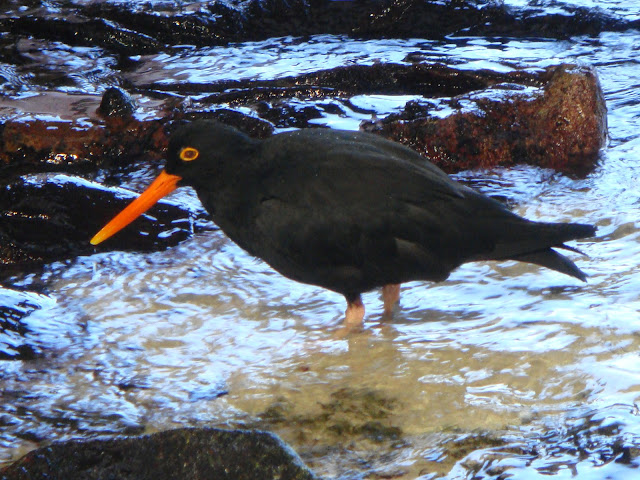
The African Black Oystercatcher is one of the most striking birds found along the rocky coastlines of southern Africa — a boldly coloured, long-lived shorebird with brilliant red eyes, a vivid orange-red bill and jet black plumage that makes it one of the most visually distinctive coastal birds in the world. Despite its striking appearance, this species is genuinely endangered with a very restricted global range and a total population of only a few thousand individuals. Here are the most amazing African Black Oystercatcher facts! Did you know? The African Black Oystercatcher has one of the smallest natural ranges of any non-island bird species — found only along a narrow strip of southern African coastline — yet it is considered a conservation success story because careful protection has helped its population recover significantly from historical lows! 🔴 One of Africa's Most Distinctive Shorebirds The African Black Oystercatcher is immediately recognisable by its dramatic combi...

Basking Shark Amazing Facts — The Ocean's Gentle Giant Filter Feeder

Image
The basking shark is the second largest fish in the world — exceeded only by the whale shark — yet despite its enormous size and fearsome appearance, it is one of the ocean's most gentle giants, feeding exclusively on microscopic plankton filtered from the water as it swims slowly with its enormous mouth wide open. Here are the most amazing basking shark facts that reveal the extraordinary biology of this ocean giant! Did you know? A basking shark's liver is so enormous it can make up 25% of the shark's total body weight — and was historically harvested so intensively for its oil that basking shark populations collapsed catastrophically across much of their range during the 20th century! 📏 The Second Largest Fish on Earth The basking shark, Cetorhinus maximus, is a genuinely enormous animal. Adults typically reach 6 to 8 metres in length, with some exceptional individuals reported at over 10 metres. They can weigh up to 5,200 kilograms — more than three times the weight of...