Posts

Stick Insect Amazing Facts — The Master of Disguise That Reproduces Without Males

Image
Stick insects — also called walking sticks or phasmids — are among the most extraordinary masters of camouflage in the entire animal kingdom, having evolved body forms so similar to twigs, leaves and bark that they are genuinely invisible in their natural habitat even to expert observers. But their camouflage is only the beginning of the stick insect's remarkable biological story. Here are the most amazing stick insect facts! Did you know? Many stick insect species reproduce entirely without males through parthenogenesis — females produce offspring that are genetically identical clones of themselves, with males of some species so rare they were unknown to science for over a century! 🥚 Reproducing Without Males — Entirely Many stick insect species are capable of complete parthenogenesis — reproduction in which females produce genetically identical offspring without any male fertilisation whatsoever. In some species this is the exclusive reproductive mode, with males either extremel...

Brush Turkey Amazing Facts — The Bird That Builds Its Own Incubator and Never Meets Its Mother

Image
The Australian brush turkey is one of the most remarkable birds in the world — a large, prehistoric-looking bird that has solved the problem of incubating eggs in one of the most extraordinary ways found in any vertebrate. Rather than sitting on its eggs like most birds, the brush turkey builds a massive compost heap, uses the heat of decomposition to incubate its eggs, and monitors and adjusts the temperature with extraordinary precision — effectively building and operating its own self-regulating incubator. Here are the most amazing brush turkey facts! Did you know? A male brush turkey maintains his compost mound nest at a near-constant 33–35°C by adding or removing material — inserting his bill deep into the mound to measure temperature with remarkable accuracy and adjusting the mound accordingly, effectively operating as a living thermostat! 🏗️ Building a Compost Incubator The Australian brush turkey, Alectura lathami, is a megapode — a family of birds that use environmental hea...

Sociable Weaver Amazing Facts — The Tiny Bird That Builds the Largest Nest on Earth

Image
The sociable weaver is a small, sparrow-sized bird from southern Africa's Kalahari region that achieves something no other bird on Earth can match — it constructs and maintains a communal nest structure so massive that it can weigh several tonnes, house over 500 individual birds simultaneously, and stand for over a century through successive generations of the same colony. Here are the most amazing sociable weaver facts! Did you know? The sociable weaver's communal nest is the largest nest structure built by any bird species — some have grown to weigh over 1,000 kilograms, standing over 7 metres tall, housing more than 500 birds, and lasting well over 100 years as generations of birds maintain and expand the original structure! 🏗️ The Largest Bird Nest on Earth The sociable weaver, Philetairus socius, builds colonial nest structures that are genuinely extraordinary by any measure. These thatched communal apartment blocks are constructed primarily on the sturdy branches of la...

Ptarmigan Amazing Facts — The Arctic Bird That Changes Colour With the Seasons

Image
The ptarmigan is one of the most superbly Arctic-adapted birds on Earth — a grouse-like bird that lives year-round in some of the most extreme cold-weather environments on the planet, surviving blizzards, temperatures of minus 40°C and months of near-total darkness through an extraordinary suite of physical adaptations. Most remarkably, the ptarmigan changes its plumage colour three times a year to maintain camouflage against changing seasonal backgrounds. Here are the most amazing ptarmigan facts! Did you know? The ptarmigan changes plumage colour THREE times a year — white in winter to match snow, speckled brown-grey in spring to match melting tundra, and brown in summer to match the vegetation — one of the most complete seasonal camouflage systems of any bird species! 🎨 Three Complete Plumage Changes Per Year The ptarmigan undergoes one of the most complete and frequent seasonal camouflage transformations of any bird species, moulting into three distinct plumage types annu...

Kiwi Bird Amazing Facts — New Zealand's Honorary Mammal With the Biggest Egg of Any Bird

Image
The kiwi is one of the world's most extraordinary birds — a flightless, nocturnal, furry-feathered creature from New Zealand that is so unlike other birds in its biology that scientists sometimes describe it as a "honorary mammal." From laying the largest egg relative to body size of any bird in the world to having nostrils at the tip of its bill for sniffing out food, the kiwi breaks almost every rule in the bird book. Here are the most amazing kiwi facts! Did you know? The kiwi lays an egg so enormous relative to its body size that it takes up roughly 20% of the female's entire body — equivalent to a human woman giving birth to a six-year-old child! The egg is so large the female can barely walk in the days before laying! 🥚 The Proportionally Largest Egg of Any Bird The kiwi's egg is one of the most extraordinary reproductive facts in all of ornithology. A female kiwi, which weighs approximately 2 to 3.5 kilograms depending on species, produces a single egg we...

Bactrian Camel Amazing Facts — The Two-Humped Desert Giant Built for Extremes

Image
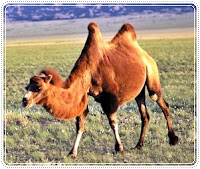
The Bactrian camel is one of the toughest and most extraordinarily adapted large mammals on Earth — a two-humped giant capable of surviving temperatures ranging from minus 40°C in winter to plus 40°C in summer, going weeks without water and drinking salt water that would be lethal to virtually any other mammal. Here are the most amazing Bactrian camel facts! Did you know? Bactrian camels can drink up to 135 litres of water in a single session — and their blood cells are oval-shaped rather than round, allowing blood to keep flowing even when they are severely dehydrated and their blood becomes dangerously thick! 💧 The Water Storage Myth — Debunked The most common misconception about camels is that their humps store water — they do not. The humps of both Bactrian and dromedary camels are fatty tissue deposits that serve as energy reserves, not water tanks. This fat storage strategy is actually advantageous for desert heat management — having fat concentrated in the humps rather than dis...

Hornbill Amazing Facts — The Bird That Walls Itself Inside a Tree for Months

Image
Hornbills are among the most extraordinary birds in the tropical world — spectacularly large, vibrantly coloured birds with massive, curved bills topped by bizarre casques that immediately distinguish them from every other bird family. But the hornbill's most remarkable characteristic is not its appearance — it is the extraordinary nesting behaviour of the female, who voluntarily imprisons herself inside a hollow tree for months, relying entirely on her mate's faithfulness for survival. Here are the most amazing hornbill facts! Did you know? The female hornbill seals herself inside a tree hollow using mud, droppings and fruit pulp, leaving only a narrow slit through which her mate feeds her and their chicks for up to four months — if the male is killed during this time, both female and chicks will starve to death inside the sealed nest! 🚪 The Sealed Nest — Complete Voluntary Imprisonment The hornbill's nesting strategy is one of the most extraordinary parental behaviours ...